- Genus: Ichthyotitan
- Species: I. severnensis
- Classification:
- Ichthyosauria
- ?Shastasauridae
- Authors: Dean R. Lomax, Paul de la Salle, Marcello Perillo, Justin Reynolds, Ruby Reynolds, James F. Waldron.
- Age: Late Rhaetian (Upper Triassic)
- Location: Blue Anchor, Somerset, UK
- Type Specimen: BRSMG Cg3178
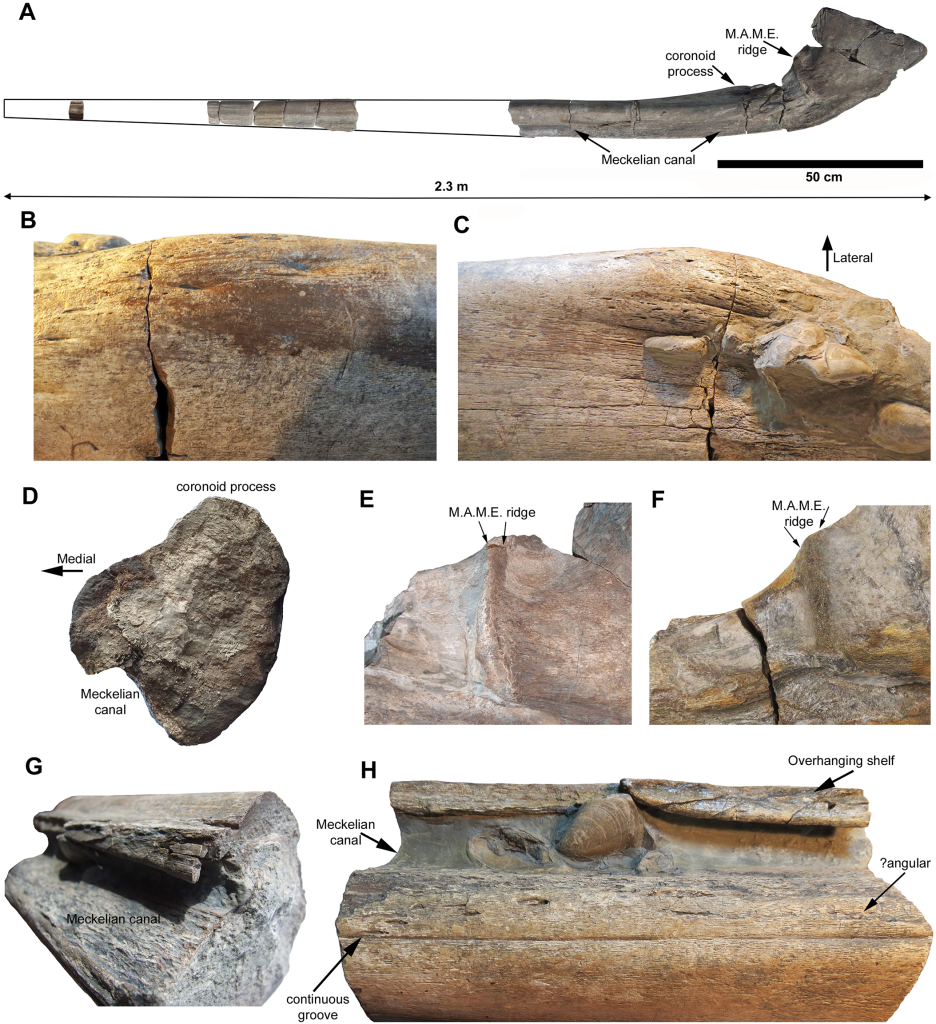
(The holotype of Ichthyotitan, taken from Lomax et al., 2024)
Ichthyotitan servernensis is a giant ichthyosaur from the Upper Triasic (approx. 202 Ma), with body size estimates of 20-25m, making it the largest described marine reptile. It has been placed within the Shastasauridae family (which includes Shonisaurus), based on it’s large size and age. Other than the holotype, there is one confirmed specimen referred to it, with possible others from multiple locations. The holotype was found in multiple stages, with the first being left on a boulder by a member of the general public on May 28, 2020. After a search of the area, the rest of the holotype was found in situ, and subsequently extracted, with the most recent piece being recovered on October 16, 2022.
The type specimen of Ichthyotitan comprises of 12 individual segments of a right surangular, including the posterior end and parts of the middle and anterior sections. Although the exact location of the find has been kept anonymous due to the possibility of more the specimen being present, the general locality is the Upper Triassic Westbury Mudstone Formation in Blue Anchor, Somerset. Although incomplete, it is estimated that the surangular would have been >2m long. Histology of the specimen also shows that it was not yet full grown, meaning even larger sizes could possibly be found.
It is distinct from shastasaurid ichthyosaurs due to a 90 degree angle bend in the posterior of the surangular, and a subcircular cross section of the shaft at the position of the coronoid. The specimen also has a small, bulbous coronoid process with minor eminance, and is laterally directed and displaced. It occupies half the width of the dorsal surface in the coronoid region, and the medial side shows slight concavity. Finally, it also presents with a massively developed dorsoventral M.A.M.E. (M. adductor mandibulae externus) ridge, with a spatulate shaped posterior end.
The Lilstock specimen
The Lilstock specimen (BRSMG Cg2488) was described by Lomax et al.,2018, and is the only referred material. It was from the same Mudstone Formation as the holotype, but was found in Lilstock, Somerset. This specimen is a more fragmentary and worn left surangular, with only the posterior end and part of the shaft present. It consists of 5 fragments that total 96cm in length, and due to the similarities of this specimen with those of the holotype, the authors were confident in their diagnosis of Ichthyotitan severnensis as a new species.
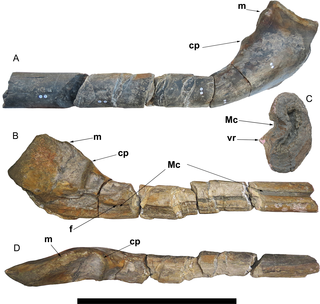
The Lilstock Specimen. Scale bar equals 50cm. Taken from (Lomax et al., 2018).
Possible Material
Other possible material includes the Aust Cliff ‘Bone Shafts’ (BRSMG Cb3869) from close to the base of the Westbury Mudstone Formation at Aust Cliff in Gloucestershire. These were at first believed to be dinosaurian, but were identified as an ichthyosaurian jaw based on the Lilstock specimen. However, due to the stratigraphic age being slightly older, and less complete, this means that the authors could not confidently assign them to I.severnensis.
Another possible specimen is the Cuers Ichthyosaur, from the Rheatian of France (Fischer et al., 2014). Although this ichthyosaur does show some similarities, the parts that are needed to diagnose it to I.severnensis are poorly preserved, and so cannot be confidently assigned.
Lastly, there are two undescribed specimens that could possibly belong this genus. One is a large piece of jaw that is currently in a private collection. And another is a fragmentary ichthyosaur recently discovered in Gabbs Valley Range in Nevada, USA. We will have to see if these are described in the future.